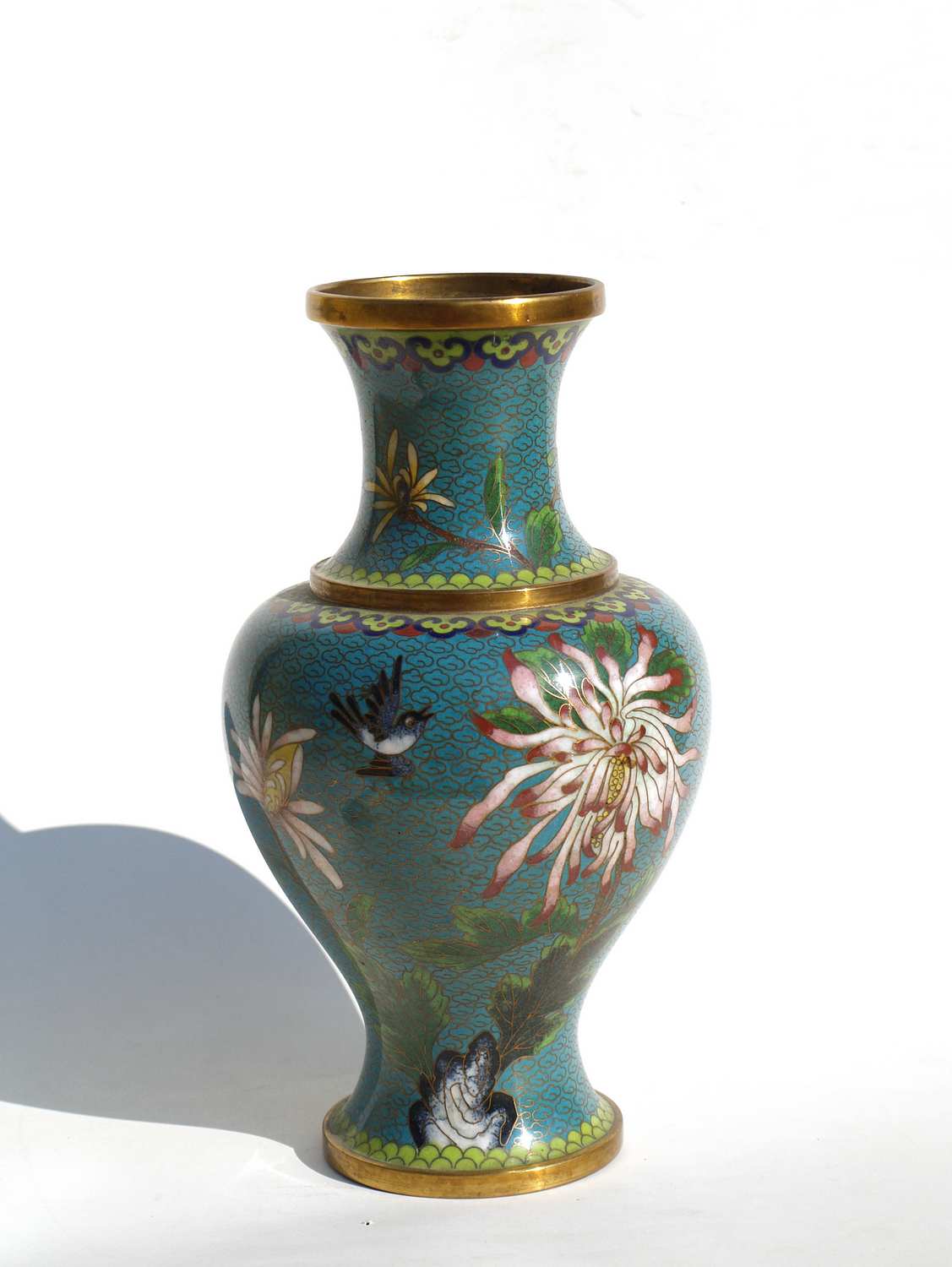
Brass vase decorated with cloisonné enamels. That of cloisonné enamels is one of the most important items of Chinese luxury craftsmanship, whose technique was imported from the West in the 14th century.
The peculiarity of the 'cloisonné' technique arises from the difficulty of obtaining a secure connection between enamel and metal. It was therefore necessary to resort to the technique of forming many small cells which were filled with enamel.
Once the bronze or copper object is made, bronze or copper or silver or gold threads (previously prepared in the form of the decoration to be obtained), are glued onto it. Then fine silver powder is spread over it and the object is then heated. The silver melts and adheres the filaments to the support. At this point the artist takes the various colors and places them in their respective cells. The colours, glass substances reduced to fine powder and mixed with water, are applied with a brush. Once the piece is placed in the stove, the glass is liquefied. This operation must be repeated several times because the vitreous paste shrinks when cooked.
In the Museum since 1901.


